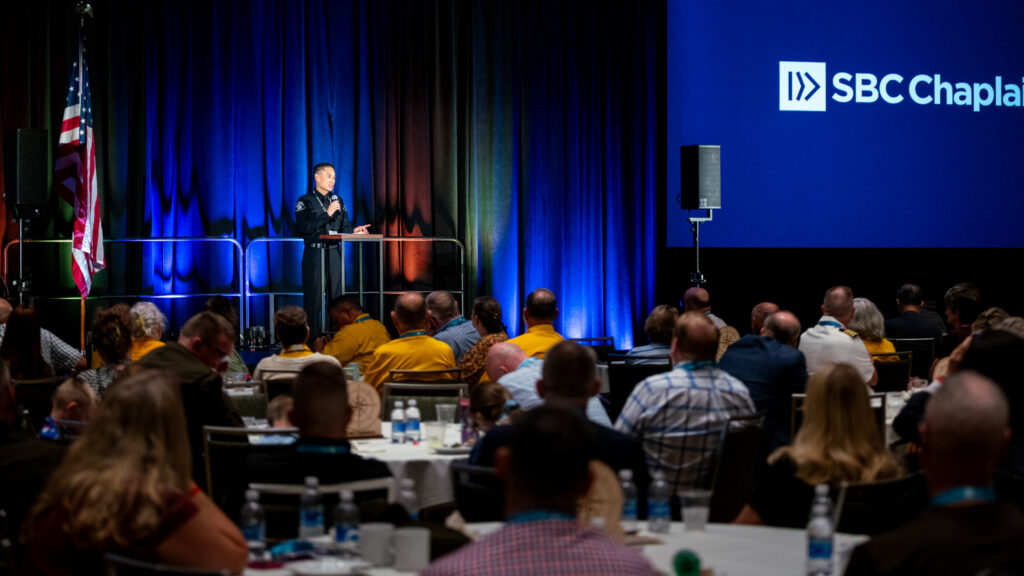
Live at the 2022 Southern Baptist Convention Annual Meeting in Anaheim, California, I hosted another episode of Faculty Dialogues with my friend and colleague, Dr. Chris Chun. We discussed the theological foundations of core Baptist doctrines like credobaptism, congregationalism and church autonomy as well as misconceptions and myths of the Baptist tradition.
Watch the full conversation below
Excerpt
David Rathel: We’re here talking about baptism, which is appropriate as a leadoff question because it is our practice of baptism that gives us our name: Baptist. But there are other components of Baptist theological identity. It’s not just a belief in credobaptism; there are other features of Baptist theological commitments, particularly how we order and structure church life. Could you talk a little bit about what it means to be a Baptist in terms of membership in a Baptist congregation? What theological principles are in play there?
Chris Chun: In terms of membership, as a Baptist, and if we use the circumcision language, which has a parallel to creedal baptism, you can say that those people who profess Christ and who were converted are now worthy of covenant ratification, which in the New Testament is through believer’s baptism by immersion. That is how we have been buried in baptism, united with Christ, and as Christ is risen, we are also risen together in Christ. So that is now the basis for covenant community and a believers’ church and of regenerate church membership.
DR: Yes, absolutely. That’s exactly right. We say baptism is for believers and then from this baptism of believers we can have a notion of regenerate church membership; that the church is comprised of regenerate people. It is from there that we can say that we are a believers’ church. Also, from there comes our polity, congregationalism. We are committed as Baptists to a congregational polity, which means that the congregation has a say in the life and governance of the church. The Baptist Faith and Message 2000 famously says it is through democratic processes that church leadership is ultimately structured. This in no way negates the office of pastor or leader or elder, but we do believe because we are a regenerate people that regenerate people are qualified and competent to have a say in church governance. As a person who’s been in Baptist life for years, what have you seen in regard to congregational polity? For example, how is it practiced at your church? Or what are some of the advantages that you see coming out of congregationalism?
CC: Well, first of all, I’m really passionate about believer’s baptism upon a profession of faith. Regarding polity, I really don’t think that the Bible gives an exact model. In terms of the subject of baptism, I think the Bible is very clear and prescriptive on it. There are different models within the country. I’m not sure the congregational model, although I believe it, is the model and that other models are false. Now, having said that, I do think the congregational model has some real strengths. For example, in terms of how you want to structure the governance, there is a lot of leeway; whatever the congregation decides to do. In a democratic process, the congregation is ultimately able to carry that task; whether that delegates the power structure to the pastor, or a board of elders or leadership committee. They vote on every issue. So there is some leeway; it can create confusion, but it is also one of our strengths.
Edited for clarity and brevity.