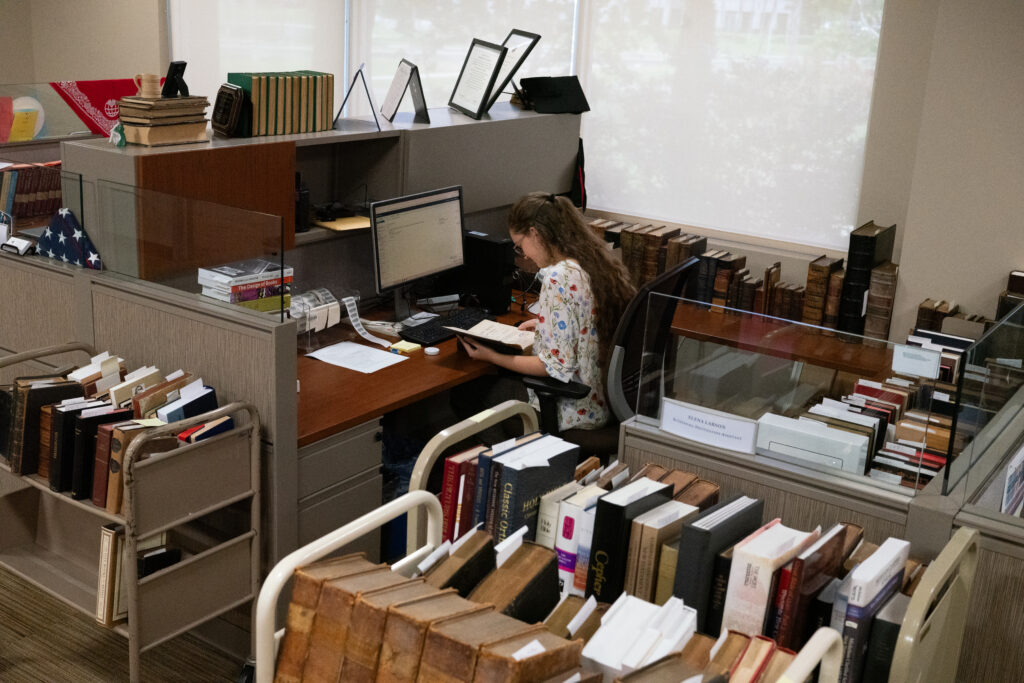
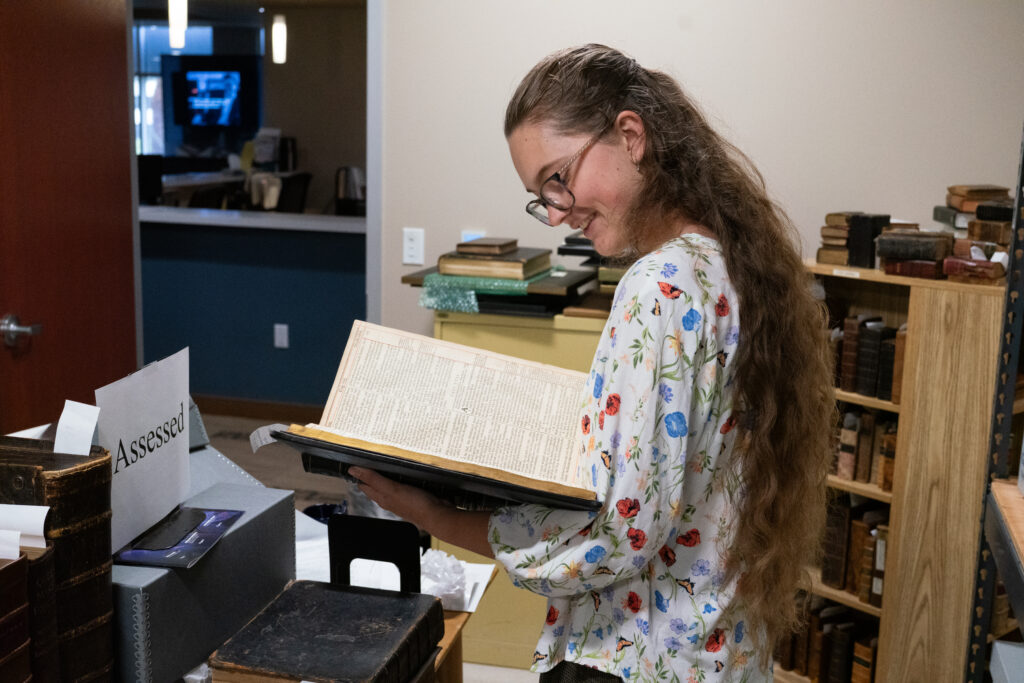
This summer I had the opportunity to work with over 1000 Bibles and Bible-adjacent books in the Kuykendall Bible Collection at Gateway Seminary.
Elena Larson
Teetering stacks of books covered my summer cubicle–a multitude of Bible translations and versions. I marveled that God’s kingdom has spread to so many languages at so many times. But I also started to wonder, have we passed the point of diminishing returns in English versions? Is this abundance serving discipleship or mere individualism?
This summer I had the opportunity to work with over 1000 Bibles and Bible-adjacent books in the Kuykendall Bible Collection at Gateway Seminary, cataloging and scanning them to expand public access. This collection of over 1500 Bible and Bible-adjacent books was donated by Michael and Terry Kuykendall in 2024, and these past months, I examined the collection spanning over 800 years and more than 30 languages.
I looked at a 1752 Welsh New Testament with a favorite Welsh hymn lovingly inscribed on the flyleaf, an 1805 book on Quaker principles and doctrines, a two-volume 1926 Yiddish Pentateuch, a 2007 Manga NLT Bible driven by vivid illustrations, and many more. In this collection are over 400 English versions, from widely used and accepted translations, such as a 2004 Holman Christian Standard Bible, to niche and experimental translation philosophies, like The Bible in Rhyme by Kyle Holt, where Holt translates the entire Bible into poetry as an attempt to make it exciting to listen to. There is an Amsterdam-published King James Bible that has the Geneva Bible notes in the margins, produced when Bible marginalia was illegal in England. There are humorous projects like the LOLCat Bible, a group project anyone on the internet could add to to “translate” the Bible to LOLCat internet meme language. There are so many versions, from amazing to ridiculous. At this point, I wonder, do we need any more?
Why are there so many English translations of the Bible? Some are made to correct ‘errors’ based on theological differences, and some are for the translator’s own growth, but many are to reach a specific audience; filling a perceived hole. With the ease of publishing and even self-publishing today, it may seem desirable to produce a version for every perceivable target group. But is this the best use of resources? It could cause confusion for readers and disunity in the body, exacerbating America’s desire for personalization and consumerism.
We seek personalization so that each reader can feel that the Bible is familiar and ‘for them.’ For example, the Cotton Patch version uses dialect variation to make the scriptures seem familiar: “a colloquial translation with a Southern accent.” But there are other ways to make the Bible approachable to people; instead of bringing the Bible to them, we could bring them to the Bible. Before the recent explosion of versions, the Bible was made familiar by a large portion of the population hearing it every week read aloud in Church and memorizing it. It shaped the way they thought, the words they used, and the language they were used to. These practices made the language of the Bible feel close and comfortable, and versions such as the Cotton Patch version attempt to imitate this closeness. In this way translations have tried to replace time and investment.
But there are other ways to make the Bible approachable to people; instead of bringing the Bible to them, we could bring them to the Bible.
As biblical language education has been declining, and fewer readers can read the Bible in the original tongue, our reliance on translations is increasing. But perhaps it would be better to address this issue at the source. If you know Hebrew and Greek, consider–instead of making a new translation–teaching the languages, discussing the meaning, and keeping the frequency of practice and reading in your churches alive.
Translations are tools, but in an oversaturated market, perhaps adding yet another English translation is not the most effective means of furthering the kingdom. In a world of declining social interaction and biblical literacy, inviting your neighbor to dinner and discussing the Bible might be a better way to show the light of Christ.